
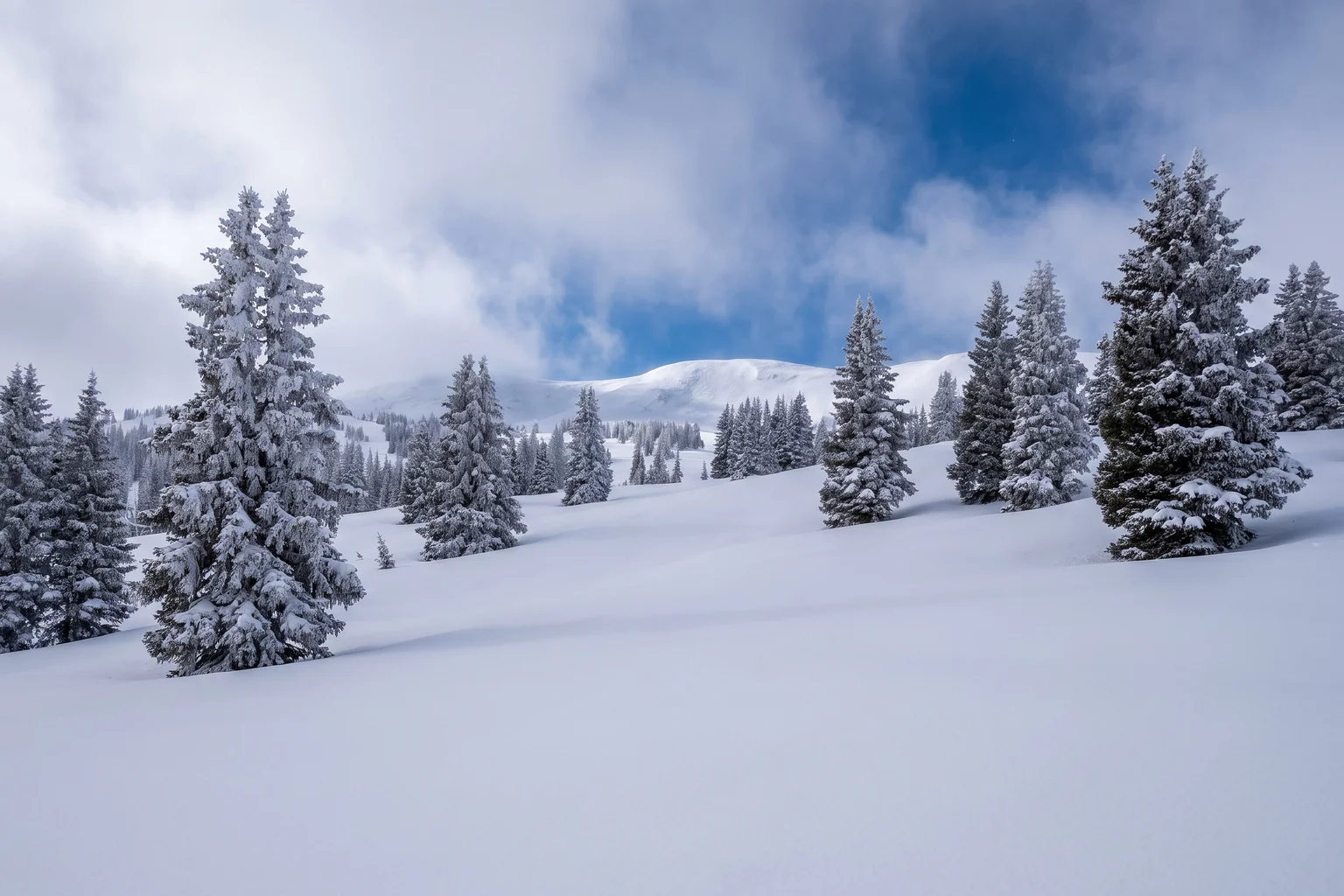
Illustrative image: fresh powder snow on an ungroomed slope among frosted spruce trees in the Colorado Rockies.
There is a particular kind of quiet in Snowmass Village the morning after a big storm: muffled streets, snow piled on every railing, and skiers already clomping toward the lifts in the half-light. A powder day is the best day of many people's season, and also the one where a little planning makes the biggest difference. Here is how to read the signs before the storm, choose where to go once it lands, and keep everyone in your group safe in deep snow.
Before the storm: where to look
Nobody can promise you a powder day, and we will not try. What you can do is watch the same sources the locals watch and be ready when one arrives.
The National Weather Service in Grand Junction
Snowmass falls under the NWS forecast office in Grand Junction. Two of its products are worth bookmarking. The point forecast (search by city or ZIP code) gives you expected snowfall for a specific spot, and the hourly forecast shows when the heaviest snow is expected. The Area Forecast Discussion, written by the forecasters themselves, explains how confident they are and why, which is often more useful than the numbers alone. If the office issues a winter storm watch or warning, it will show on the same page.
The official snow report
Once the snow starts, the authority is Aspen Snowmass's Snow and Grooming Report for Snowmass. Alongside it is a raw-data page fed by on-mountain weather stations, which Aspen Snowmass says is "updated every hour throughout the day." That raw feed is how you spot snow that fell after the morning report, the mid-day refills that reward people who stay out after lunch. The grooming report on the same page tells you which runs were groomed overnight, which matters more than you might think: on a deep day, a freshly groomed run under new snow is the kindest place to start.
Season dates and lift hours are posted on the official sites, and they can change with weather. Check the snow report and lift status on the morning you ski rather than relying on anything you read weeks earlier, including here.
The night before: get organized
- Lay out gear. Goggles with a low-light lens, a neck gaiter, dry gloves and an extra layer. Flat light is common during and right after storms. Our packing list covers the rest.
- Agree on a plan. Decide who skis with whom, where you will meet if you get separated, and a time to check in. Phones die fast in the cold, so a fixed meeting place and time is the real backup.
- Eat breakfast early. Powder skiing is tiring, especially at altitude, and lines for lunch on busy days can be long.
Choosing terrain on a powder day
Snowmass has a lot of room to spread out. Aspen Snowmass describes "more than 3,300 acres of skiing and riding," along with the mountain's "endless cruisers," "dozen-plus tree trails" and "the steeps and powder fields of Hanging Valley." Which part of the mountain suits your group depends far more on ability than on where the deepest snow fell. Our existing guides go into each area in detail:
- Intermediates: start with the Big Burn, the wide, open heart of the mountain, or the runs around Elk Camp. Wide terrain lets less experienced powder skiers keep their speed up and stop when they need to.
- Strong experts: Hanging Valley Wall and the Cirque are Snowmass's best-known steep terrain. Steep terrain may stay closed after a storm while ski patrol works, so check lift and terrain status on the official site rather than heading up on hope.
- Families with younger kids: powder is hard work for small legs. A few runs in soft snow at the edges of groomed trails, then a break, will keep the day fun.
One more thing: closed means closed. Aspen Snowmass's safety rules say plainly that skiers and riders "shall not enter a trail that is closed," and patrol closes terrain when it judges it necessary. On a storm day, those closures exist for a reason you usually cannot see from the top.
Deep snow safety: tree wells and immersion
The single most important powder-day safety topic is not avalanches; it is deep snow immersion. Aspen Snowmass's on-mountain safety page describes it as a skier or rider falling "into an area of deep unconsolidated snow," which is what happens in a tree well, and states that leaving the groomed trails means "voluntarily accepting the risk of a deep snow immersion accident." That page points to a dedicated tree well and deep snow safety website for detailed guidance on reducing that risk, and we would encourage every adult in your group to read it before you head into the trees.
The basic idea is simple: in the trees on a deep day, ski with someone you can see, and who can see you.
The boundary and the backcountry
The fresh snow just past the ski area rope is tempting. Aspen Snowmass is clear that "there is no ski patrol, avalanche control or services beyond the ski area boundaries," and that rescue there falls to the Pitkin County Sheriff's Office. Avalanche conditions outside the boundary are forecast by the Colorado Avalanche Information Center (CAIC). Leaving the ski area is backcountry travel and calls for avalanche training, rescue equipment and a current CAIC forecast. If your group does not have all three, keep your powder day inside the ropes.
Pacing the day
Powder days burn energy fast. Take a real lunch break, drink water, and call it a day before someone is too tired to ski well. If the snow keeps falling, the raw-data page will tell you whether an afternoon lap is worth it.
Staying at Stonebridge for a powder morning
On a storm morning, the less time you spend getting to the lift, the more first runs you get. Stonebridge Condominiums is ski-in/ski-out, next to the Village Express lift at Fanny Hill, and on-site ski storage attendants look after skis and boards, so you can walk out the door with your boots on. At the end of a deep day there is a heated outdoor pool and two outdoor hot tubs, and the condos have fireplaces and fully equipped kitchens for a quiet dinner in.
Planning a winter trip? Check availability or call us at 1-800-323-2577.
Frequently Asked Questions
Where do I find the Snowmass snow report?
Aspen Snowmass publishes a Snow and Grooming Report for Snowmass on its website, plus a raw-data page from on-mountain weather stations that it says is updated every hour throughout the day.
Which weather office forecasts for Snowmass?
The National Weather Service forecast office in Grand Junction, Colorado. Its site offers point forecasts by city or ZIP code, hourly forecasts, winter weather products and the Area Forecast Discussion.
What is a tree well or deep snow immersion accident?
Aspen Snowmass describes it as a skier or rider falling into an area of deep unconsolidated snow, and says that leaving the groomed trails means voluntarily accepting that risk. Its on-mountain safety page links to further guidance on reducing that risk.
Is there ski patrol outside the Snowmass boundary?
No. Aspen Snowmass states there is no ski patrol, avalanche control or services beyond the ski area boundaries, and that backcountry rescue falls under the Pitkin County Sheriff's Office.
Can I ski a closed trail on a powder day?
No. Aspen Snowmass's safety rules say skiers and riders shall not enter a closed trail; ski patrol closes trails when it deems necessary.
Sources
- Snowmass Snow and Grooming Report — Aspen Snowmass
- Snowmass Snow Report Raw Data — Aspen Snowmass
- On-Mountain Safety — Aspen Snowmass
- NWS Forecast Office Grand Junction, CO — National Weather Service
- Colorado Avalanche Information Center — Colorado Avalanche Information Center
- But, Which Mountain Do I Ski? — Aspen Snowmass