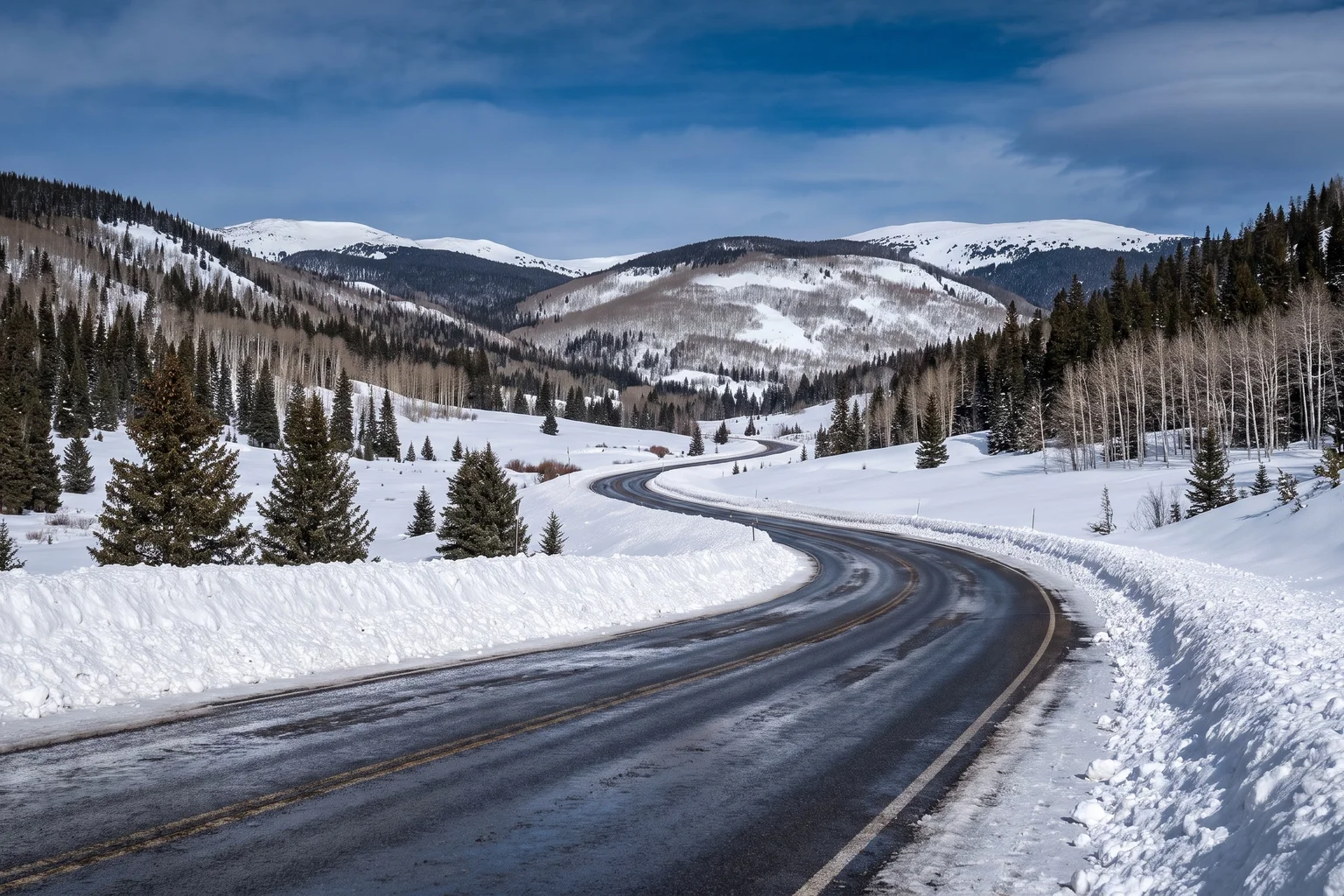
Illustrative image: a plowed two-lane mountain highway winding through a snowy Colorado valley in winter.
Snowmass is a wonderful place to arrive in winter, and the drive in can be part of the adventure, provided you know what Colorado expects of you and your car. Mountain roads here are plowed and well managed, but storms move fast, one of the famous scenic routes closes entirely for the season, and Colorado has specific tire and chain rules that apply on the way. Here is what to know before you set off, all taken from the Colorado Department of Transportation and the local transit authority.
Check the road before you leave
CDOT's advice is short and worth repeating: "Call 511 for current road and weather information or visit COtrip.org." COtrip is CDOT's traveler information site, and CDOT's winter driving page also offers a way to subscribe to COtrip alerts, so closures and restrictions come to your phone instead of the other way around. Check it the night before and again before you leave; conditions on a mountain highway can change within hours.
It is also worth watching the weather forecast for the whole route, not just for Snowmass. A clear day in the village does not mean the interstate passes are clear.
Colorado's Traction Law, in CDOT's words
Colorado has two levels of winter tire rules for passenger vehicles. CDOT explains both on its traction and chain law page.
The Traction Law
When the Traction Law is in effect, CDOT says your vehicle needs "tires with 3/16" tread depth that are rated 'all weather' or winter tires (mountain-snowflake icon or M+S or M/S)," or you must "carry chains or an approved alternative traction device." CDOT also "highly recommends driving an AWD or 4WD vehicle in the mountains whenever possible."
Two details catch visitors out:
- It is in force for most of the season on I-70. CDOT states the law applies on I-70 from Morrison to Dotsero between Sept. 1 and May 31. If you are driving from Denver, your route uses that stretch.
- It is not limited to I-70. CDOT "can implement traction and chain laws on any state highway," which includes the roads to Snowmass.
The Chain Law
During severe winter storms, CDOT can put the Passenger Vehicle Chain Law in place, which it describes as "the final safety measure before the highway is closed." When it is in effect, "every vehicle must have chains or an approved alternative traction device." CDOT notes that both laws can be enforced with fines; its page lists the current amounts.
A note on rental cars
If you are renting a car at the airport, ask the rental company what tires the car has and whether chains or traction devices are allowed, before you leave the counter. CDOT's rules apply to the vehicle you are driving, whoever owns it.
Independence Pass is closed in winter
Look at a map of Colorado and the shortest line toward Aspen from the east runs over Independence Pass on Colorado Highway 82. In winter, that road is not an option. CDOT closes CO 82 over the pass, between Aspen and Twin Lakes, for the season. In its announcement for the 2025/2026 winter, CDOT explained that "plowing steep switchbacks on CO 82 on either side of the pass is unsafe during extreme winter conditions," and that sections of the road are exposed to significant avalanche hazards. That closure took effect Nov. 17, 2025.
CDOT says it "typically reopens the pass the week prior to the Memorial Day holiday weekend," weather permitting and after crews have evaluated the road. Navigation apps do not always know this, so if your phone suggests Independence Pass between fall and late spring, ignore it.
The alternate route CDOT gives from the Denver area is westbound Interstate 70 to Glenwood Springs, then south on CO 82 toward Aspen. Snowmass Village is off CO 82 on that road. Our guide to getting to Snowmass Village covers the full set of options, including flying.
Packing the car
CDOT's winter driving pages include a section on winter driving preparedness. At a minimum, families making a long mountain drive usually bring warm layers for everyone, water and snacks, a phone charger, an ice scraper and a flashlight, and keep the fuel tank well above empty in case of a long delay. Our Snowmass packing list covers what to pack for the trip itself.
Leave the driving to the bus
Once you arrive, you may not need to drive much at all. The Roaring Fork Transportation Authority (RFTA) runs two routes that serve Snowmass Village, according to its Snowmass Village routes page:
- Snowmass Aspen (SM), which RFTA describes as "a FREE service between Snowmass Village and Aspen." It is a good way to spend an evening in Aspen without worrying about parking or driving home on snowy roads.
- Snowmass Valley (SMV), running "downvalley to Glenwood Springs." RFTA notes that "service to downvalley requires a fare," and that bus transfers are required at the Brush Creek Park & Ride for downvalley and Aspen-bound routes.
Schedules change by season, so check RFTA's current timetables and its BusTracker before you rely on a particular bus.
Arriving at Stonebridge
Stonebridge Condominiums is at 30 Anderson Lane in Snowmass Village. Each condo comes with one complimentary parking space, and once the car is parked it can mostly stay there: Stonebridge is ski-in/ski-out next to the Village Express lift at Fanny Hill, and the original Snowmass Village "is a 5- 8 minute walk," as our home page puts it. Our complimentary shuttle runs during office hours, including airport pickups at Aspen/Pitkin County Airport and trips around the village; call the front desk to arrange one.
Ready to plan your winter trip? Check availability or call 1-800-323-2577.
Frequently Asked Questions
Is Independence Pass open in winter?
No. CDOT closes CO 82 over Independence Pass, between Aspen and Twin Lakes, for the winter season because plowing its steep switchbacks is unsafe in extreme conditions and parts of the road are exposed to avalanche hazards. CDOT says it typically reopens the week before Memorial Day weekend, weather permitting.
How do I drive to Snowmass from Denver when Independence Pass is closed?
CDOT's alternate route is westbound Interstate 70 to Glenwood Springs, then south on CO 82 toward Aspen. Snowmass Village is reached from CO 82.
What tires does Colorado's Traction Law require?
CDOT says tires must have 3/16-inch tread depth and be rated all-weather or winter tires (mountain-snowflake icon, M+S or M/S), or you must carry chains or an approved alternative traction device. CDOT also highly recommends AWD or 4WD in the mountains.
When is the Traction Law in effect on I-70?
CDOT states the Traction Law is in effect on I-70 from Morrison to Dotsero between Sept. 1 and May 31, and that it can implement traction and chain laws on any state highway.
Where do I check Colorado road conditions?
CDOT says to call 511 for current road and weather information or visit COtrip.org, where you can also subscribe to alerts.
Is there a bus between Aspen and Snowmass Village?
Yes. RFTA says its Snowmass Aspen (SM) route is a free service between Snowmass Village and Aspen. Its Snowmass Valley (SMV) route runs downvalley toward Glenwood Springs and requires a fare.
Sources
- Winter Driving — Colorado Department of Transportation
- Passenger Vehicle Traction and Chain Laws — Colorado Department of Transportation
- CO 82 at Independence Pass closes for the winter season — Colorado Department of Transportation
- COtrip Traveler Information — Colorado Department of Transportation
- Snowmass Village routes — Roaring Fork Transportation Authority
- RFTA — Roaring Fork Transportation Authority